The report of battery test with a "Desulfator".
| The Battery data of Mercedes Benz C230 / W202 (1996 year model) |
| Installed system |
Desulfator 12 (12V) |
| Installed date |
February 9, 2003 |
| Battery |
Mercedes-Benz genuine battery (12V 100Ah) |
| Density of the battery liquid and voltage 2003 |
2004 |
2005 |
| Cell number |
February
9 |
March 2 |
March 15 |
Dec. 2 |
June 5 |
Dec. 3 |
June 12 |
Final Test
Dec. 18 |
| (+) 1 |
1.250 |
1.275 |
1.275 |
1.275 |
1.280 |
1.260 |
1.260 |
1.29(1.277) |
| 2 |
1.250 |
1.275 |
1.285 |
1.275 |
1.275 |
1.270 |
1.270 |
1.30(1.287) |
| 3 |
1.230 |
1.275 |
1.275 |
1.275 |
1.280 |
1.280 |
1.270 |
1.30(1.287) |
| 4 |
1.240 |
1.270 |
1.275 |
1.275 |
1.280 |
1.260 |
1.270 |
1.30(1.287) |
| 5 |
1.250 |
1.275 |
1.275 |
1.275 |
1.275 |
1.265 |
1.280 |
1.30(1.287) |
| (-) 6 |
1.250 |
1.270 |
1.270 |
1.280 |
1.270 |
1.260 |
1.280 |
1.30(1.287) |
| Average density |
1.245 |
1.273 |
1.276 |
1.275 |
1.276 |
1.265 |
1.271 |
1.29(1.277) |
| Maximum density |
1.250 |
1.280 |
1.285 |
1.280 |
1.280 |
1.280 |
1.280 |
1.30(1.287) |
| Minimum density |
1.230 |
1.270 |
1.270 |
1.275 |
1.270 |
1.260 |
1.260 |
1.29 |
| Density difference |
0.020 |
0.010 |
0.015 |
0.005 |
0.010 |
0.020 |
0.020 |
0.01 |
| voltage(V) |
12.20 |
12.41 |
12.45 |
12.73 |
12.78 |
12.60 |
12.61 |
12.55 |
| Measured time |
16:00 |
14:00 |
16:00 |
9:00 |
12:30 |
14:30 |
15:00 |
16:00 |
| Temp.(Celsius) |
- |
- |
- |
17 |
27 |
18 |
30 |
2 |
| CCA value |
- |
- |
- |
- |
- |
- |
369 |
275 |
| Comment |
Should
be
replaced |
Good |
Good |
Good |
Good |
Good |
Good |
Should
be
replaced |
| If the density of the battery liquid is over 1.26, it's normal. |
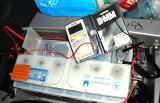
■February 9, 2003
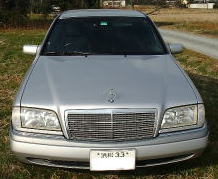
Install the 12V desulfator on Mercedes Benz C230 which has been 6 years
since new. All the cells show under 1.26. The third cell shows 1.230, therefore,
this battery should be replaced.
■March 2
All the cells show over 1.260. The acid density went up.
■March 15
All the cells show good condition. The acid density went up. (The battery
revived.)
■Conclusion
Although this battery was facing to last, it revived by 12V desulfator. |
■December 2, 2003 measured the density and voltage
This battery has been working for 7 years since new. The odometer shows
41,891km = 26,181miles.
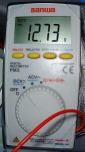
The aicd density of the all cells show over 1.27. The voltage shows 12.73V.
As a result, this battery has a good acid density and voltage which shows
a good condition.
If "Battery Desulfator" was not be installed on this battery,
this battery might have been gone because of the low acid density and voltage.
In Japan, February is the most cold season, so the lead battery tends to
flat in the winter.
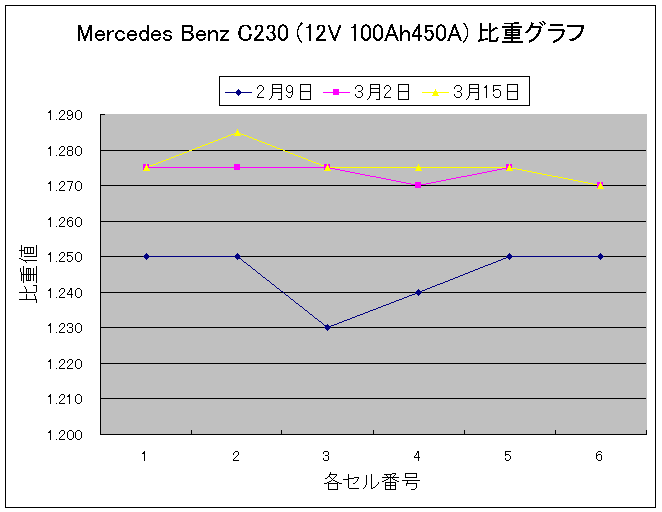
Check the graph at the bottom of this page. If the acid density shows over
1.26, the battery condition is good.
■This battery was facing to flat.
All cells showed the low density on Feb. 9, 2003 and number 3 cell showed
1.23. This battery had been working for 6 years at that time. Actually,
I felt that what a long durability this battery had. However this battery
should have been replaced and it was about to down.
Three reasons are considered that why this battery had been working for
6 years.
The odometer showed that this car had not been running the long distance,
however we could not come to the conclusion. For example, if the owner
seldom drives the car, the battery tends to run out of electricity. Furthermore,
the sulfation tends to attatch on the element plates in this case.
1. This battery is in the trank room.
Some of the Mercedes Benz, Jaguar and BMW have the batteries in the trunk
room. It is said that if the heavy battery is installed in the trunk room,
the weight balance of the car is more better. This design also has side
effects. This battery in the trunk room is not influenced by the high temperature
in high summer. The lead acid battery is sensitive to the temperature,
so this is a ideal way.
2. This battery has enough capacity for the 4 cylinders engine.
This battery has 100Ah capacity. Mercedes Benz E class has also same size.
This Mercedes Benz C230, the battery load is less than E class which has
6 or 8 cylinders.
3. This Mercedes Benz was imported by the regular dealer.
This Mercedes Benz was imported by the regular dealer, therefore, electric
parts which are alternator and computer, are modified in order to fit the
Japanese traffic circumstance and crimate.
In Japan, some imported cars are imported by the independent car dealers
who import the cars from the foreign countries directly. These imported
cars are not modified like avobe, therefore the batteries tend to be replaced
in the short terms. In Japan especially Tokyo, traffic jam is terrible,
moreover the temperature and humidity is very high in summer. It is said
that these reason makes the battery short life.
 ■The lead acid battery can revive ■The lead acid battery can revive
This battery does not have to be replaced definitely now. The boltage and
acid density show as a good battery.
This battery(VARTA) is made of high quality parts. The high quality battery
has almost 10 years durability physically. Therefore, the lead acid battery
can obtain the long durability by preventing the sulfation.
The battery life depends on the physical durability of the element plates
by the desulfator.
■Result of the automobile inspection (Finished on December 2003)
In Japan, the car has to take the automobile inspection every two years.
However, if the owner buys a new car which has to take the inspection three
years later. The inspection cost is high for Japanese ! We envy the American
inspection system. The following PDF files are written in Japanese.
The mechanic refilled the battery liquid. Of course, No replace the battery.
He seemed "What's going on ?"
■"Battery desulfator" was installed on February 2003
The battery desulfator was installed on February 2003 and keep going well
until now. Although this car is not drived every day, the engine can start
easily anytime anywhere. This battery has not have any trouble since new.
■Conclusion
Japanese desulfator can resolve the sulfation into Pb (lead) and SO4 (sulfuric
acid) and prevent the sulfating on the element plates. So the owners only
check the amount of the battery fluid sometimes. That's it !
In case of the MF (Maintenance free battery), the owners don't have to
check the battery fluid. Yes, it's going to be a real MF battery, isn't
it?
If this battery were gone, the following reasons were considered.
- The element plates and separators are damaged physically.
- The battery got a strong shock physically.
Resolving and preventing the sulfation is the best way to prolong the battery
life.
■Acid density graph in 2003
| The report of battery test with a "Desulfator"- Type 2 |
■June 12, 2005
 |
 |
 |
 |
 |
 |
| No1 cell |
No2 cell |
No3 cell |
No4 cell |
No5 cell |
No6 cell |
| ← From plus terminal to minus terminal → |
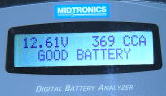 All the cells show over 1.26. The color of the battery liquid is clear. All the cells show over 1.26. The color of the battery liquid is clear.
I checked the CCA value this time. The genuine Mercedes Benz battery has
450A (Cold cranking current).
Normal CCA value : 450
This time CCA value : 369
369×1/450×100 = 82% (against the normal)
Japanese desulfator was installed on the Merceds Benz which had been 6
years since new. Therefore, CCA value must had been dropped at that time.
Now this battery shows that although voltage and acid density are normal,
CCA value drops. This means the element plates are getting be old.
Although this battery has been 8.5 years since new, it's still working.
I'm going to check it out on Dec. 2005 next time. If I recognized the senescence
of the battey, I'm going to decide that it should be replaced or not.
This long-term test shows that the lead battery can work for a long time
by preventing the sulfation even the old battery. It is said that the element
plates of the lead battery have the changeable volume when charged and
discharged. This phenomenon influences the battery permanence. I recognize
that the high quality battery has the high performance element plates.
On the other hand, the cheap battery has a short life because of the low
quality element plates.
■December 3, 2004
 |
 |
 |
 |
 |
 |
| No1 cell |
No2 cell |
No3 cell |
No4 cell |
No5 cell |
No6 cell |
| ← From plus terminal to minus terminal → |
This is a "density measure" for the lead battery. ↑
The open type battery is filled up by the battery liquid which consists
of fine water and sulfuric acid.
The measure stick, which has red, yellow and green zones, shows the density of the battery liquid.
- All the surface of the battery liquid locates in the green zone.
- The battery liquid is clear.
The relative density of the battery liquid goes down a little bit than
the previous check. Therefore, it was guessed that the element plates were
getting be old.
This battery has been working since new, therefore, it's a sufficient result.
It's been 8 years !
However, I found the fact on the car maintenance document. This Mercedes Benz
was checked by the Mercedes Benz car dealer on Dec. 1.
Maintenance Document 2004 PDF
Sorry, this document is written in Japanese.
This document shows that a bottle of fine water was refilled into the battery.
This means the battery liquid became a little bit thin.
Therefore, The relative density of the battery liquid goes down slightly than previous.
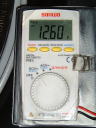 ■Couclusion ■Couclusion
This battery still has a good condition. It's been 8 years since new !
The voltage is 12.60V.
As you know, it's impossible to use the car battery for 8 years. This result
shows that the used lead battery can work for 8 years by using "Desulfator".
This test to be continue...... |
|
![Battery Desulfator from Japan [Nanopulser PG-12S, PG-12N, PG-24S, PG-24N] The lead-acid battery can revive and extend the battery life by Pulse Technology](eco_system_for_the_lead_acid_battery.header.jpg)