 Japanese Pulse Technology Japanese Pulse Technology
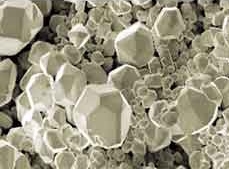
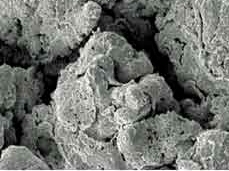
■This system cleans up the Sulfation
| Before |
|
After |
|

|
 |
 |
 |
|
| Covered by Sulfation |
|
Resolve the sulfation gradually |
|
Patent applied. |
| Click Here |
|
|
■The mechanism of Japanese Pulse Technology
■Stage 1 - Sulfation is resolved intoPb and SO4
Japanese battery desulfator outputs the special pulse wave(10,000Hz) into the
lead-acid battery. Then sulfation(PbSO4) is resolved into Pb
(lead) and SO4 (sulfric acid) gradually. This pulse wave is
very weak, therefore, this technology never attack the element plates and it's a
safety system for the lead-acid battery.
■Stage 2 - Sulfation melts down
Sulfation is resolved into Pb and SO4. Then Pb and SO4 ion melt down into the battery fluid. They never deposit at the bottom of the battery.
:info.
Some of the desulfators vibrate the element plates and remove sulfation,
therefore, it dameged the element plates and the battery fluid gets muddy.
■Stage 3 - The lead-acid battery revives by charging
repeatedly
When the lead-acid battery is charged, Pb ion goes back to the element plates
and SO4 ion melts down into the battery fluid. Then 2H2So4(Sulfuric acid) is generated. After that,
the acid density of the battery fluid and maximum voltage goes up gradually.
Finally the battery performance goes up.
:info
Acid density - This
means the density of the battery fluid. The new lead-acid battery has 1.28 acid
density.
■Unti-aging
The element plates always keep fresh and finally the battery life can be
prolonged by Japanese pulse system. The high quality lead-acid battery has a
long durability physically. Therefore, the lead-acid battery can work until the
last of the element plates and output the stable power. |
 How long does it need to revive the battery ? How long does it need to revive the battery ?
 It depends on the battery size and the using term. It depends on the battery size and the using term.
| The battery for vehicle and boat |
Fit desulfator |
How long ? |
| Motorcycle battery |
Nanopulser
PG-12S |
~10 days |
| Car battery (For Mini Van under 70D class) |
Nanopulser
PG-12S
PG-12N |
10~20 days |
| 4WD, SUV battery (80D~105D class) |
Nanopulser
PG-12S
PG-12N |
2~4 weeks |
| 4WD with Diesel engines (Two batteries in series) |
Nanopulser
PG-24H |
2~4 weeks |
| MercedesBenz, BMW, AUDI, Jaguar battery |
Nanopulser
PG-12N |
3~4 weeks |
| Under medium truck (Two batteries in series) |
Nanopulser
PG-24H |
2~4 weeks |
| Full size truck and bus (Two batteries in series) |
Nanopulser
PG-24H |
Appro.1 month |
| EB battery for electric chair (Two EB batteries in series) |
Nanopulser
PG-24H |
2~3 weeks |
| EB battery for electric sweeper and car (Two EB batteries in series) |
Nanopulser
PG-24H |
3~4 weeks |
| EB battery for electric transportation (Three EB batteries in series) |
Nanopulser
PG-36C |
Appro. 1 month |
| Small electric fork lift (24V) |
Nanopulser
PG-24H |
Appro. 1 month |
| Medium electric fork lift (48V) |
Nanopulser
PG-48F |
1~2 months |
●If the battery is charged repeatedly, the battery performance goes up
like above.
●While the battery is discharging, the desulfator prevents sulfating on
the element plates.
After the battery has revived, can I take the desulfator out ?
If the desulfator is taken out, sulfation will attach on the element plates
again gradually. The desulfator should be installed all the year in order
to extend the battery life.
How much electricity does the desulfator consume?
"Nanopulser PG-12S and PG-12N" consume 0.035A (ampere).
It's a tiny electricity. Many vehicles are controled by the car computer
which also consumes a tiny electricity while the engine stops. However,
it does not matter.
How can I check the density of the battery fruid?
Use "Density tester" or "Battery analyzer".
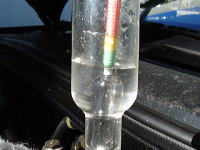 Density tester Density tester
The floater has three zones which are green, yellow and red. If the surface of the liquid is located in green zone, the battery condition is good. The good condition shows over 1.25.
←The floater has a scale marked.
The battery liquid is clear.↑
This picture shows good condition of the battery liquid. The good condition
battery outputs over 12.60V.
|
